The Press Portrait: One Image, Several Jobs
A press portrait can introduce a performer, suggest a genre, and draw attention; learn what its framing communicates—and what the image cannot establish.
A press portrait can introduce a performer, suggest a genre, and draw attention before a viewer sees a scene. Its framing also sets limits: a photograph can show a chosen pose and setting, but it cannot establish a performer’s private character or the full nature of a production.
Imagine a publicity team preparing an image for an invented performer, Mara Vale, who has a supporting role in a mystery film. The team needs a portrait for a press packet and a theater’s film page. Its task is not simply to make Mara look striking. The image must identify her, hint at the film’s tone, and leave enough room for viewers to become curious.
One portrait, three jobs
The team begins by separating the portrait’s aims. First, it should make Mara recognizable as the performer attached to the project. Second, it should signal a genre without claiming to explain the whole film. Third, it should attract a glance in a crowded press packet or page.
Those aims can pull in different directions. A dramatic image may catch attention but obscure the face. A neutral headshot may identify Mara clearly but carry little sense of the mystery. The practical choice is to make identification the foundation, then use restrained visual cues to suggest tone.
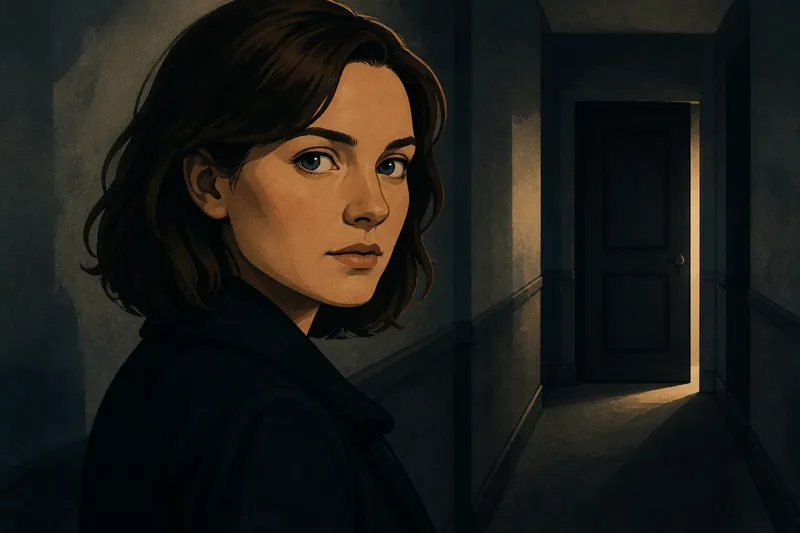
For this imagined portrait, the photographer frames Mara from the shoulders up against a dim hallway. Her face remains plainly visible; a closed door and a narrow strip of light provide atmosphere. The hallway suggests suspense, but it does not turn the photograph into a plot summary.
Framing builds a message
Each visible choice contributes to the portrait’s public meaning. A direct gaze can feel open or challenging. A turned shoulder can imply distance. A plain background keeps attention on the face, while a location adds context but may also invite viewers to treat a staged setting as a real clue.
Wardrobe and expression need similar care. Mara wears a dark coat that fits the film’s restrained mood, rather than a costume that would make her appear to be a detective. Her expression is attentive, not frightened. That choice gives the image a suspenseful register without asserting that her character is in danger in every scene.
Lighting also guides attention. The photographer keeps enough light on Mara’s features for the image to function as an introduction, while allowing the background to stay shadowed. The useful question is not whether the portrait looks mysterious in isolation, but whether a viewer can still tell who it presents.
From camera to press packet
The team reviews the image at the sizes and in the settings where it is likely to appear. On a theater page, a small crop may discard the hallway and leave only Mara’s face. In a printed press packet, a larger version may preserve the setting. A portrait that depends on a small background detail to communicate its mood may therefore lose that signal when cropped.
Say the theater’s page uses a square crop. In this invented situation, the team checks a square version and sees that the original crop cuts off the closed door. It shifts the frame slightly so Mara’s face remains clear and a sliver of the hallway survives. The expected result is a thumbnail that still identifies her and carries a modest suggestion of suspense.
The accompanying caption should do a different job from the image. It can name Mara and her role, giving viewers straightforward context without asking the portrait to prove anything about her. A caption that calls her “the film’s mysterious investigator,” for instance, would mislead readers if she plays a witness instead.
What does a press portrait communicate?
Can one image introduce an unfamiliar performer?
It can offer a clear, recognizable view that helps viewers connect a face with a name. A caption or press packet supplies the factual identification that the photograph alone cannot provide.
How does a portrait signal a genre?
Setting, lighting, wardrobe, and expression can point toward a mood such as suspense or comedy. These are visual suggestions, not evidence that every scene or performance follows the same tone.
Does a publicity portrait show the performer’s real personality?
No. It records an image made for a particular public purpose, shaped by posing, styling, selection, and cropping. Treat it as a designed presentation rather than a candid account of private life.
What should a viewer check before reading into an image?
Look at the caption, the project context, and what the frame actually includes. Separate visible details from interpretations, especially when the setting or expression seems to hint at a story.
What the image cannot establish
The portrait does not reveal how much of Mara’s role appears in the film, how she performs in a scene, or what she is like away from publicity. Nor does a shadowed hallway confirm that the film is uniformly dark in tone. Those claims require information beyond a single still.
This boundary matters because a polished portrait can feel unusually persuasive. Viewers may read a serious expression as evidence of seriousness, or a glamorous outfit as proof of a character’s status. The image may invite those readings, but invitation is not confirmation.
For a publicity team, the same limit is useful. The portrait can create interest without pretending to settle every question about the performer or production. Keep the caption accurate, and let the image offer atmosphere rather than unsupported biography.
Lessons from the portrait
In the imagined case, the final image gives Mara a legible face, a restrained suspense cue, and enough visual space to survive a smaller crop. It does not explain her character or claim to represent her private self. The team has made one image serve several purposes by giving each purpose a clear boundary.
When you encounter a press portrait, use that distinction as your reading habit: notice what the frame makes easy to see, then ask what its choices encourage you to infer. The press portrait works best as an invitation to pay attention—not as proof of the story behind the face.