Stage Name or Screen Credit? Two Different Choices
Stage name or screen credit? Learn how to separate a performer’s public identity from a production’s role listing and keep each use clear.
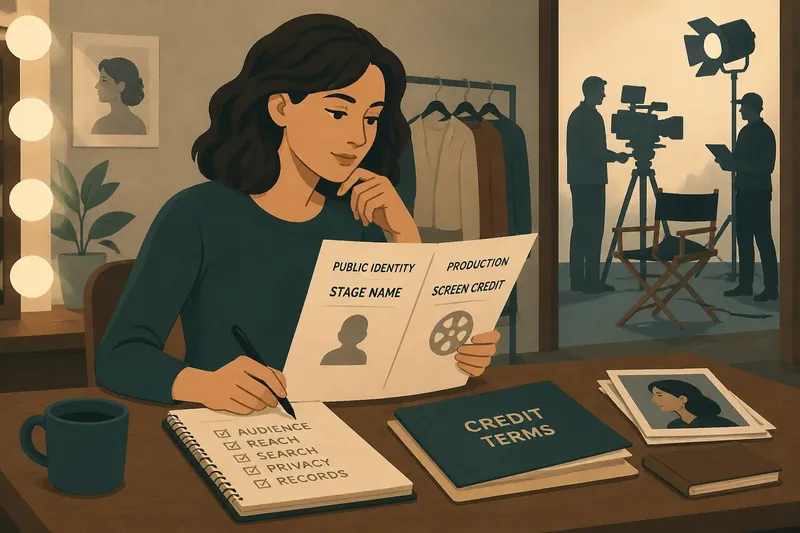
A stage name or screen credit answers a different question: one identifies a performer across public life, while the other names a contribution to a particular production. Before a performer chooses either, it helps to know which audience will see the name and which record will carry it.
A public name may appear across auditions, interviews, and live appearances. A screen credit belongs to a specific work and may be handled differently from one production to another. The distinction is useful, but the exact credit process depends on the project’s agreement and the rules that apply to it.
Public Identity
A stage name is a professional identity a performer may use across multiple projects and appearances. It can be a chosen name, a variation on a legal name, or an established professional name. Its main purpose is continuity: audiences can connect performances, interviews, and announcements with the same person.
A screen credit, by contrast, identifies a performer’s contribution to one film or television production. The names may match, but they do not have to serve the same purpose. A performer may use one public name over time and discuss a different credit for a particular role, subject to the project’s terms and applicable rules.
Think of a stage name as the name a performer offers to the public over time, and a screen credit as the name attached to one piece of work. They answer different questions: “Who is this performer?” and “Who is credited here?”
Write down the intended audience and use before settling on a name.
Production Credits
Credits identify contributors to a production, including performers, writers, directors, editors, and composers. For an actor, a credit can help audiences recognize a role, search for other appearances, or distinguish a speaking part from a brief appearance. Its wording and placement may matter, but the conventions and decision-makers vary by project.
Do not assume that a stage name automatically determines a production’s credit. Ask who will collect or submit the name, what form is proposed for the on-screen titles, and whether the production will use the same form in its own cast information. A distributor, database, or publicity outlet may handle its records separately, so the performer should distinguish a production’s commitments from how outside listings are created.
For a role under consideration, request the relevant written terms and confirm the name before publicity materials are prepared. If the project involves a union agreement or a consequential credit dispute, ask a qualified representative in the applicable jurisdiction to explain the rules rather than relying on a general assumption.
Confirm the production’s exact commitment; do not treat every later listing as under its control.
Audience Context
Different audiences meet a performer’s name in different settings. A casting professional may see a résumé or agency listing; a viewer sees opening titles or end credits; a theater audience hears a name spoken aloud; and a journalist may use it in an interview. A public name can link those encounters, while a screen credit places a name inside one work.
That distinction can help a performer make a deliberate choice about recognition. Someone seeking one consistent professional identity may prefer the same name across projects and publicity. Someone working in distinct fields may choose to separate contexts. No single arrangement has the same meaning for every audience, so consider where each name will appear and what connections viewers might make.
Say a performer uses “Mara Vale” for theater and interviews and is offered a small screen role under a different credit. She asks the production to put the proposed name in the written credit terms, then checks the on-screen title and the production’s cast information when available. The expected observable result is that the production uses the agreed form in the materials it controls; outside listings may still connect the names or use a different entry.
Choose names by audience and context, not by assuming every viewer will interpret them alike.
Reach and Privacy
A stage name can travel beyond a film’s titles. It may appear in audition materials, theater programs, interviews, social profiles, publicity announcements, and professional correspondence. That breadth can support recognition, but it also requires consistency across channels.
A screen credit has a narrower role, though it may later be repeated in catalogs, databases, or promotional material. A performer seeking recognition should consider whether a particular credit helps audiences connect the work with the public identity they already know.
Separation can also be intentional. A performer may prefer distinct names for privacy, work in different fields, or because another professional identity is already established. But a different screen credit is not a privacy barrier: production records and other public disclosures may still connect the names.
List where each name will appear, then decide whether the overlap is intentional.
Search and Records
Search tools do not always connect different names automatically. A role credited under a variation may be hard to find from the performer’s usual name, while a common name can be confused with another person or unrelated results.
Before using a professional name, check its spelling, punctuation, and pronunciation in ordinary searches and in relevant performer directories. If the performer belongs to a union or professional organization, consult its current name and credit guidance for the applicable work. These checks can reveal ambiguity; they cannot establish that a name is unique or that every listing will use it.
If a performer uses more than one name, an official profile or biography can explain the relationship where appropriate. Keep the explanation factual, and retain a record of the exact name attached to each production so future résumés and inquiries identify the work accurately.
Check existing uses and spelling before placing a name on new materials.
Credit Questions?
Can a performer use a stage name and a different screen credit?
That may be possible, but the project’s written terms and applicable rules determine what name can be used for a specific production. Confirm the arrangement with the responsible production contact before relying on it.
Does a stage name automatically appear in a film’s credits?
No. A stage name does not automatically become the credit for every project. Ask which name the production will use in its agreement and on-screen titles, and clarify which cast or publicity records it controls.
Can a screen credit keep a role private?
A different credit may make a role less immediately connected to a performer’s usual public identity, but it cannot ensure privacy. Records, publicity, or outside listings may still connect the names.
Who can explain credit rules?
Start with the production contact responsible for cast information and request the relevant written terms. For a union-covered project, a dispute, or a significant legal consequence, consult a qualified union representative, agent, or entertainment lawyer familiar with the applicable jurisdiction.
Decision Checks
Use these checks before a name is circulated. Each observation points to a next action rather than assuming every production follows the same process.
- Check whether the proposed name is spelled consistently in the role offer and draft agreement; if it differs, ask the production contact to clarify or correct the written terms before signing.
- Check whether the agreement states the on-screen credit form; if it does, compare it with the performer’s preference, and if it does not, ask whether the name can be specified in writing.
- Check who supplies the cast information; if the production names a responsible contact, send that person the preferred spelling, and if responsibility is unclear, request a contact before materials are prepared.
- Check whether production-controlled cast materials use the same name as the on-screen credit; if they do, retain the approved version, and if they do not, ask which form is intended for each use.
- Check whether publicity copy is produced by the project or an outside outlet; if the project controls it, request the agreed form, and if an outside outlet controls it, provide accurate information without assuming the production can dictate the listing.
- Check whether a union or professional agreement applies; if it does, consult its current credit guidance, and if the terms remain unclear or consequential, seek advice from a qualified representative in the relevant jurisdiction.
Distinct Choices
Stage name or screen credit is not a choice between two versions of the same thing. A stage name can support recognition across a career; a screen credit identifies a contribution within a production. Some performers use one name for both purposes, while others have reason to separate them.
For a decision you are making now, write the proposed name beside each intended use: audition materials, agreement, screen titles, production cast information, and publicity. Mark every difference, identify who controls that entry, and ask what written terms or rules apply. That record keeps a public identity choice distinct from a production credit and makes the limits of each decision clearer.