A Watch Party Built Around One Performance Choice
A watch party built around one performance choice gives your group a clear way to compare readings of a scene while keeping discussion on screen.
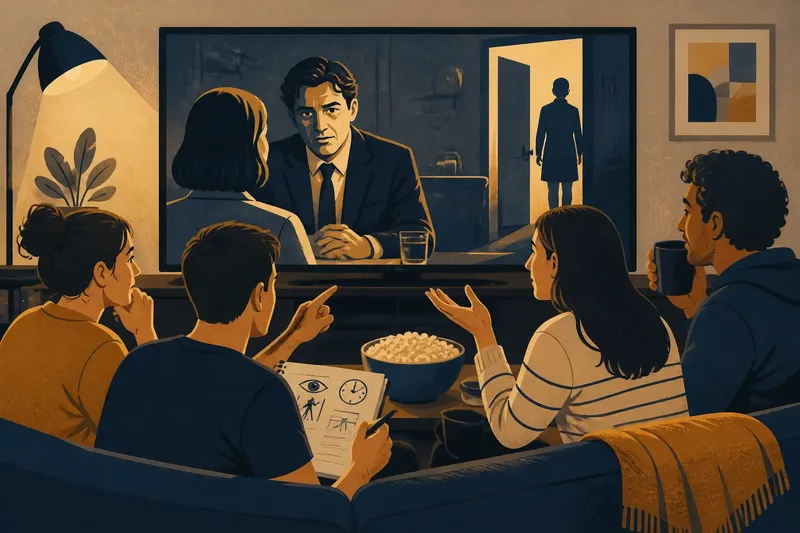
A watch party built around one performance choice works best when everyone knows what to notice but no one is told what it means. Choose a visible action—such as a delayed reply or a glance toward a doorway—and let guests compare their readings after the scene.
Choose a viewing approach
Three formats work well: watch straight through and discuss afterward, pause at selected moments, or replay a short passage for close comparison. Pick the one that suits the group’s habits and the material.
Continuous viewing
Let the film or episode play without interruption. Ask guests to note moments when the chosen behavior appears, then discuss them afterward. This preserves suspense and lets viewers follow a complicated plot without stopping to analyze every scene.
Before pressing play, describe the choice neutrally. “Watch for when the character looks away during a question” points to an observable action. “Watch for signs the character is lying” steers guests toward a conclusion.
Planned pauses
Pause at natural breaks, such as the end of a scene or after a major exchange. Invite brief observations, then resume. This format gives guests room to think aloud while keeping the story moving.
Use pauses sparingly. If the group stops every time the behavior appears, viewers may hunt for evidence instead of following the scene. Pick likely moments in advance, but leave room for an unexpected instance.
Short replay
Watch the full selection first, then replay one brief passage if the group disagrees about what happened. A replay suits viewers who enjoy close attention to timing, expression, or blocking. Skip it when repetition would spoil a first viewing or frustrate the group.
Say you choose a scene in which a character answers a difficult question after a pause. One guest hears hesitation, another reads restraint, and a third notices a glance toward the door. Replaying the passage can clarify the sequence of visible actions without requiring everyone to agree on their meaning.
Pick an observable choice
A useful focus is concrete enough to spot and open enough to support more than one reading. Look for an action that may change with context: an actor’s gaze, the timing of a response, a hand held still, distance from another character, or a shift in vocal pace.
Avoid broad labels such as “charisma” or “sadness.” Those describe an impression rather than a visible choice. Narrow the focus to something viewers can point to, such as a smile before an answer or the way a character uses a doorway during tense scenes.
Keep the discussion tied to the performance rather than treating the actor as the character. Discuss what the scene presents and how it shapes your reading. Don’t use a role to speculate about the performer’s relationships, personality, health, or motives outside the screen.
If the group is new to this kind of viewing, choose one behavior and one title. A narrow focus gives everyone common ground without asking them to watch the same scene in exactly the same way.
Match the method to guests
For a mixed group, continuous viewing is an easy entry point. Guests can watch at their own pace and contribute afterward; anyone who prefers quiet can listen or pass.
Choose planned pauses if the group likes conversation and the story has clear scene breaks. Tell guests in advance that there will be stops, and keep each pause brief enough to preserve the thread of the story.
Use a replay when guests enjoy close observation and the passage is short enough to revisit without derailing the event. If the group is watching a mystery or tightly paced sequence, save the replay until after the first full viewing.
For remote gatherings, agree on how to pause before starting. One host can control playback and signal discussion points while guests keep notes locally. Streaming services and devices handle shared playback differently, so keep the plan simple and use the controls available to the group.
Shape the discussion
Offer a prompt rather than asking for a verdict. Try: What did you notice? When did the choice change? What else in the scene might explain it? How did the choice affect your reading of the character or relationship?
Separate observation from interpretation. “The actor turns away before the answer” describes what appears on screen. “The character is ashamed” is one possible reading. That distinction keeps disagreement specific and makes room for different responses.
Keep the conversation anchored in the work. Lighting, camera distance, editing, dialogue, and performance can all affect what viewers notice. Discuss how those elements interact, but don’t turn a group viewing into claims about what the performer must be like off screen.
- Check that the focus names one visible action or vocal choice; if guests can spot it in a scene, keep it, but if it relies on a broad label such as “charisma,” narrow it to a specific behavior.
- Check that the invitation gives the focus without supplying a preferred interpretation; if it stays neutral, send it, but if it tells guests what the action means, rewrite it.
- Check whether the group wants uninterrupted viewing; if suspense or plot is the priority, watch straight through, but if guests want to compare observations, plan a few pauses.
- Check whether a disagreement concerns a brief passage; if replay would clarify the visible sequence, revisit that passage, but if the moment is better experienced once, discuss it from memory.
- Check that each prompt asks for an observation before an explanation; if guests can point to what happened on screen, continue, but if discussion jumps to a verdict, ask what action prompted it.
- Check that the discussion stays with the role and the scene; if a comment turns into speculation about the actor’s private life, redirect it to what the work shows or move to another observation.
Which viewing format fits?
What performance choice should a group track?
Pick a recurring behavior that can be described plainly, such as gaze, pauses, posture, or distance between characters. It should be specific enough to notice but broad enough to appear with context.
Should the host reveal the focus beforehand?
Yes, if the aim is shared attention rather than surprise. Name the visible choice without explaining what it supposedly means, so guests can form their own readings.
How can guests disagree without spoiling the mood?
Ask each person to point to a moment that supports their interpretation, then allow for another reading of the same scene. Keep comments about the character and performance, not the actor’s private life.
What if the behavior appears only once?
Use the moment as a discussion prompt, but don’t force a pattern the film or episode does not provide. If the group wants to compare recurring choices, select a different focus for another viewing.
Make the choice
Choose continuous viewing for a relaxed gathering or a story best experienced without interruption. Pick planned pauses when guests want guided conversation, and reserve a replay for a group that enjoys examining a brief passage closely. You can also combine methods: watch straight through, discuss, then replay only if the group has a real question about what appeared on screen.
Keep the event’s promise modest: one performance choice, several readings, and no need to settle the meaning. A focused watch party works when everyone leaves with a sharper sense of what they noticed and the freedom to disagree about why it mattered.
Put the plan in the invitation: name the action, say whether playback will pause, and invite guests to bring curiosity rather than a verdict. That small boundary helps keep the conversation about how the scene works.